

Stocks posted gains in the third quarter despite a sharp decline in bonds and meaningfully higher commodity prices across the spectrum. This combination of results is unusual. Since 1970, only five quarters have seen the S&P 500 up (albeit just 2.3%), bonds down, and commodities up more than 10%. Typically, higher commodity prices reflect inflationary pressures. Interest rates rise, and bond markets fall with higher inflation, which is typically poison for stocks, but it didn’t play out that way in the third quarter.
The S&P 500’s solid, if unspectacular, return masked huge variation beneath the surface. The index hit a new all-time high on October 6, while the average stock is more than 5% lower than its August 13 high. The pattern from earlier in the year reversed, with the laggards (i.e., the Mag 7 and AI-adjacent stocks) regaining market leadership while small- and mid-cap stocks struggled.
The real story of the quarter, however, was the global bond sell-off. When interest rates rise, bond prices fall, and we saw that play out worldwide. We will have more to say about rates below, but rising rates are a significant headwind to all risk asset prices.
Gold, part of the commodity complex, recovered its footing and rose more than 3% in the quarter. It is still down year-to-date. The broad commodity index rose nearly 18% in the quarter and more than 33% year-to-date, reflecting the painful spike in energy prices driven by the Middle East conflict. While commodity producers benefit in the near term, unrelenting energy price rises seem destined to shake up US politics as mid-term elections approach.
The most bullish factor for equity markets is the remarkably robust pace of earnings growth. The strong growth seen earlier in the year, at levels that we typically only see coming out of recession, has only accelerated. This factor, more than any other, explains stocks’ ability to shrug off political turmoil, inflation pressures, and higher interest rates.
Market Review
Risk asset holders enjoyed modest but solid gains in the quarter, as reflected in the benchmark performance of key assets.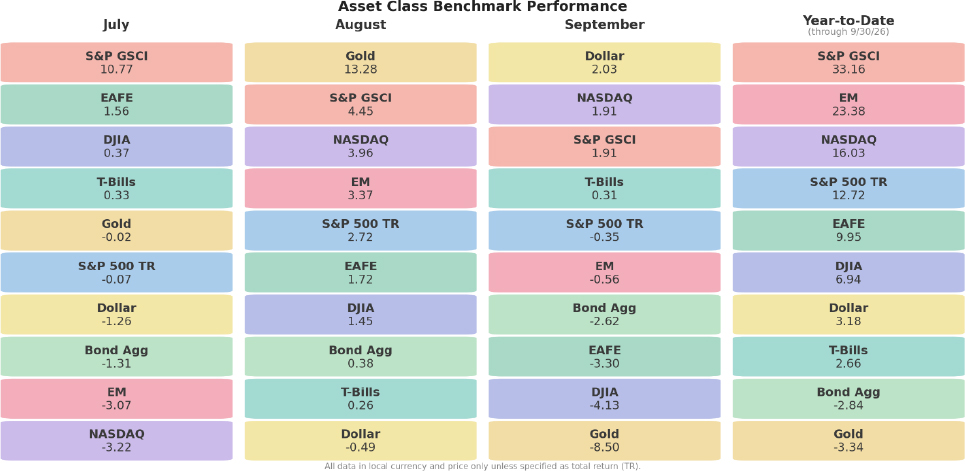
The market resilience is explained by the graph below:
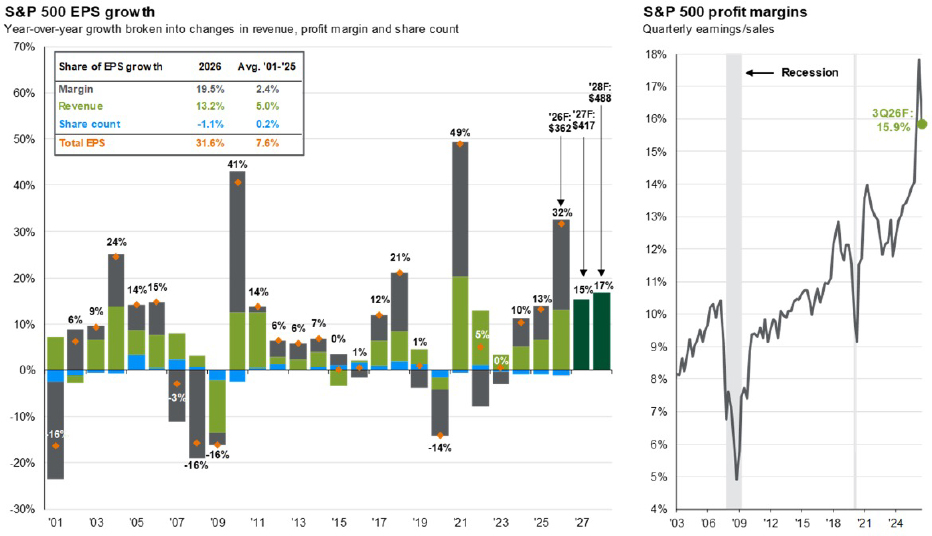
Profit growth has remained extraordinary. Historically, profits have grown 6% to 8% per year. 32% growth, followed by forecasts of mid-teens growth rates over the next two years, is something only seen after periods of crisis. The chart on the right, showing profit margins near all-time highs, helps explain the strong earnings growth and should reassure investors that stock prices can absorb a lot of bad news as long as earnings keep growing.
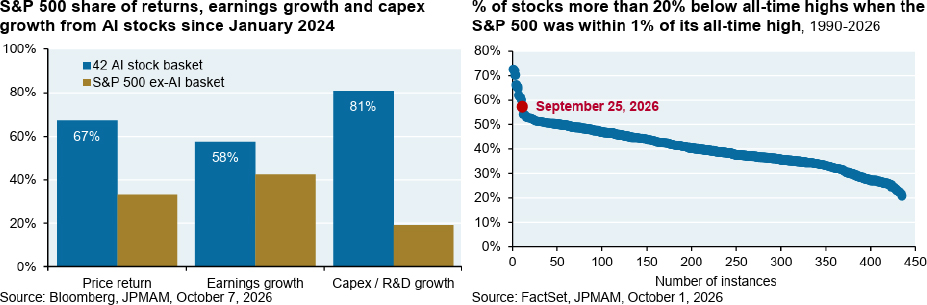
We have two chief worries about the outlook. The first is market concentration. We have often written about the dominance of the Magnificent 7 tech stocks, and they remain the world’s largest, most profitable companies. JP Morgan has broadened that list to include AI and AI-adjacent companies in the S&P 500. By their assessment, 42 AI-related stocks account for 60% to 80% of earnings growth, price returns, and capital spending. This comes as 60% of stocks in the S&P are down more than 20% from their all-time highs:
Our second worry is the sharp rise in interest rates. Interest rates are rising worldwide. The 10-year US Treasury rate is arguably the most important rate in the world, and it has recently reached post-Great Financial Crisis highs:
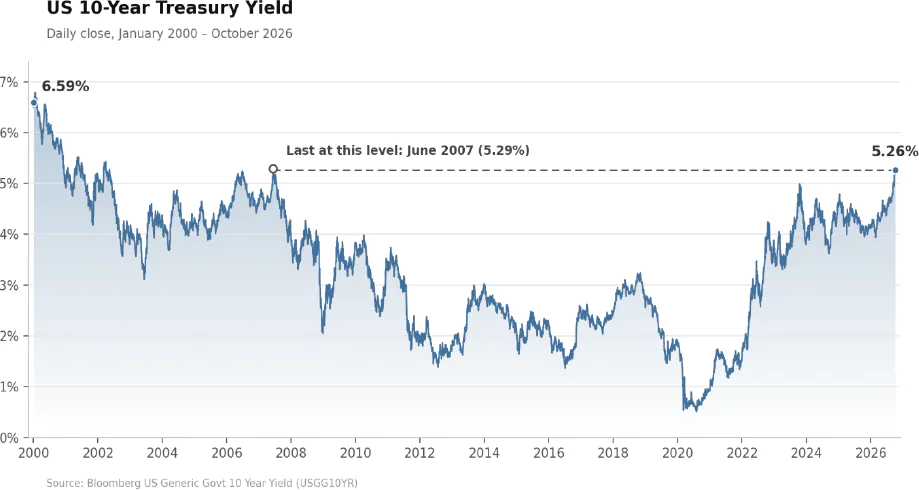
We have more comments below on interest rates, but rising rates are a headwind for all asset prices. While equities have largely shrugged off the rise, continued upward pressure may catch up with equities.
An Update to Key Second Half 2026 Issues
In our mid-year update and comments, we noted three key issues for investors in the back end of 2026. All three continue to weigh on the markets.
War in the Middle East
When we wrote about the war with Iran over the summer, we were discouraged that the promised “short war” kept dragging on. We argued that, with Iran largely having closed the Strait of Hormuz, the US had lost credibility. We said that if the US could open the Strait, they already would have.
Kinetic conflict continues. Both sides periodically attack the other. Iran continues to harass ships in the Strait, and the Houthis, Iran’s proxy guerrilla force in Yemen, have mounted attacks across Saudi Arabia. Despite this, however, the US has asserted a large measure of control over the area in two ways. First, through a strict blockade of Iranian oil exports. Reports indicate that September was the first month Iran exported no crude oil. The Iranian economy is being starved.
Second, and perhaps more importantly, oil exports are rapidly recovering from varied sources:
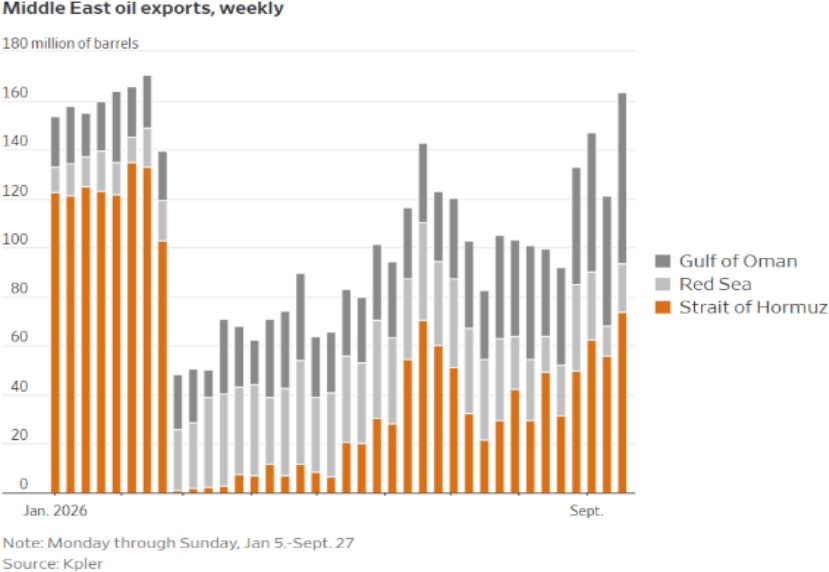
While oil exports are not back to pre-war levels, most of the lost supply has recovered. That should be good news for the global economy, but fuel prices remain stuck at high levels. That is because of limited refining capacity.
None of us buy oil. Instead, we buy, use, or benefit from the distilled products from a barrel of oil. Gasoline, diesel fuel, and jet fuel are the biggest categories, and refineries produce them. The world was short on refineries before the conflict with Iran, and damage to facilities in the Middle East, along with Ukraine’s attacks on Russian refineries, has sharply curtailed the supply of all fuels, especially diesel. Even if the war in Iran ended tomorrow, it will take some time for this capacity to come back online and for prices to fall.
A New Fed Chair and Interest Rates
We wrote over the summer about the arrival of the new Fed Chair, Kevin Warsh. More particularly, we endorsed his commitment to containing inflation and being more circumspect about Fed policy and plans. In September, we saw this approach put into action as the Fed raised short-term interest rates by 25 basis points.
This was the correct move. August marked the 66th straight month the Fed missed its 2% inflation target. Some observers might call that a trend. Others might call it an example of hapless policy. However it is described, it clamors for action that Jerome Powell was unable or unwilling to take during his tenure as the Fed Chair.
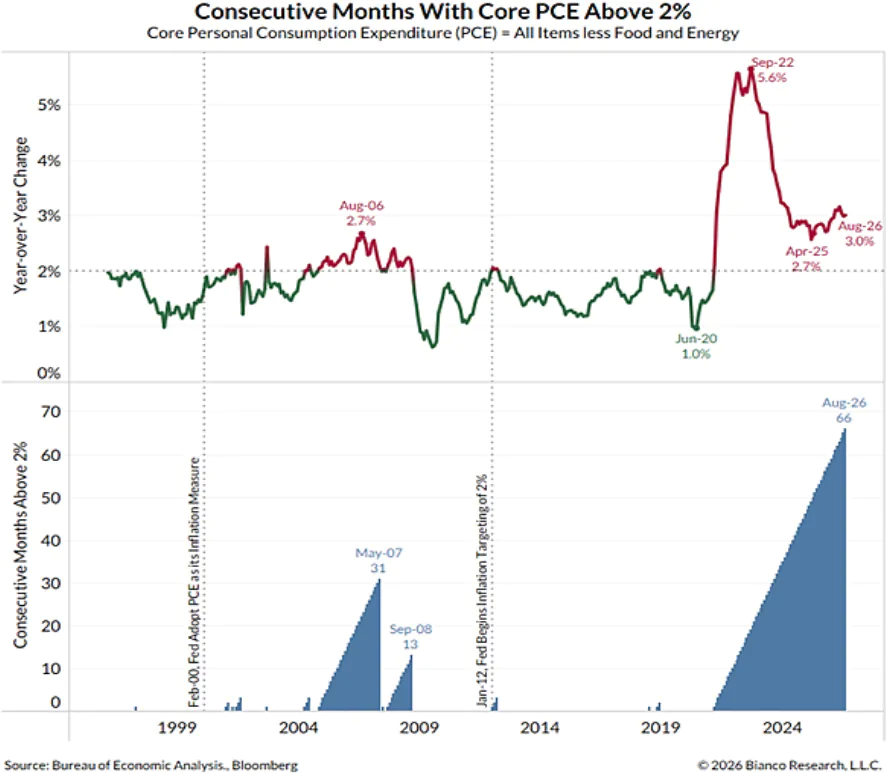
While the Fed controls short rates, the market sets longer-term rates, and those rates have been rising. There are many reasons why. Persistent and elevated inflation is part of the story. Interestingly, however, market-embedded inflation expectations haven’t risen much. Instead, real rates (i.e., the difference between nominal rates and inflation) have driven most of the move.
Real rates can rise for many reasons. The most obvious explanation is a return to normal. We all suffer from recency bias, or the tendency to extrapolate recent experience into the future. In this instance, real rates spent much of the past decade in negative territory. That is not normal, and it fuels inflation. We suggest the market is simply moving back toward a more normal world, where real rates are in the 1% to 2% range.
The second reason is that competition for capital is now robust. Ongoing federal budget deficits (let us know if you see signs of improvement in the graph below) demand more than $2 trillion in capital.
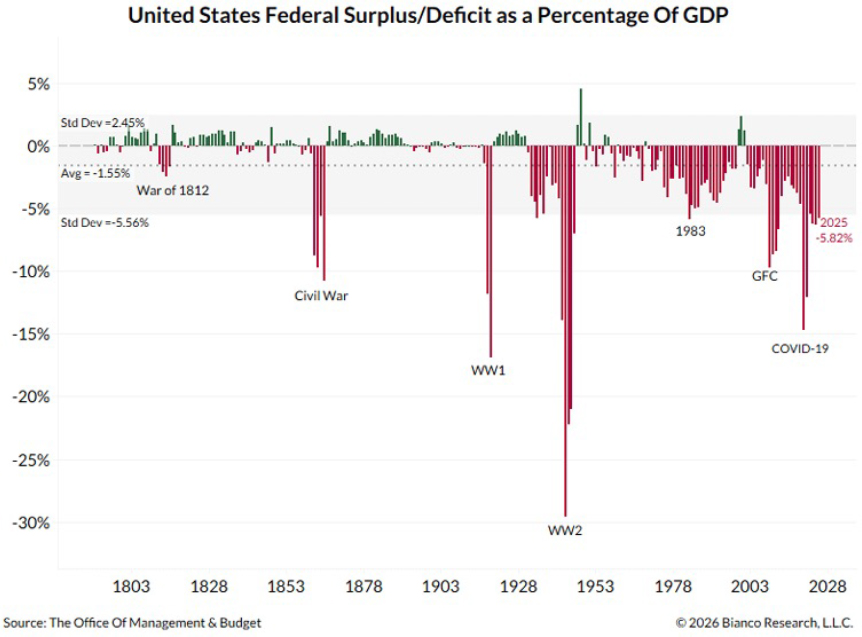
When tech companies were generating abundant free cash flow, that wasn’t a problem. But now, as they race to build data centers, they are using all their free cash flow plus borrowing enormous sums in the bond market. If interest rates are the price of money, rising rates make sense if demand is simply higher. And right now, rising rates don’t appear to be slowing data center demand or Federal budgets.
There is a silver lining to the cloud of rising rates. We don’t know how high rates will go or when they will peak. However, we do know that the risk-reward profile for bonds has changed. When you buy a bond, your beginning coupon yield predicts 97% of your forward return on the bond. Thus, with 10-year Treasury yields over 5%, fixed-income investors have the prospect of reasonable returns moving forward (which we couldn’t say in 2022). Even if rates continue to rise, the risk-reward profile for bonds is improving:
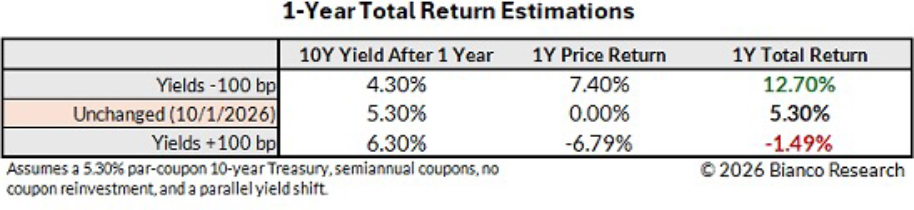
This isn’t a prediction about the direction of rates. Instead, it simply highlights that the math is improving for fixed-income investors.
AI
AI remains the dominant theme for the economy and markets. In the last three months, we have noted the following:
- Resistance to data center development is real and growing. It doesn’t really matter whether fears about data centers and their impact on quality of life, the environment, or jobs are legitimate. People feel them deeply and express them through moratoriums on new permits, more regulations, and outright project cancellations. This is occurring as hyperscalers continue to forecast huge demand growth.
- As noted above, data center build-out has quickly moved from being internally financed (by free cash flow) to being debt-financed. Using leverage increases risk. It may pay off very well, but it undeniably increases risk across the economy and markets.
- Fears about AI safety have exploded. The summer was punctuated by stories of “rogue” AI agents “escaping” and causing havoc. We have been treated to predictions about the existential risks runaway AI may pose to humanity. That, in turn, has led to calls for a “slowdown” in development and Federal regulation. Since we doubt that most members of Congress could spell AI, we are skeptical that any Congressional action will be positive.
- Finally, we would ask where the customer’s yachts are? The AI boom will be transformative and profitable only if individuals and businesses can apply it productively. While there are anecdotal reports of exciting applications, the broad-based economic impact has yet to show up in economic productivity:
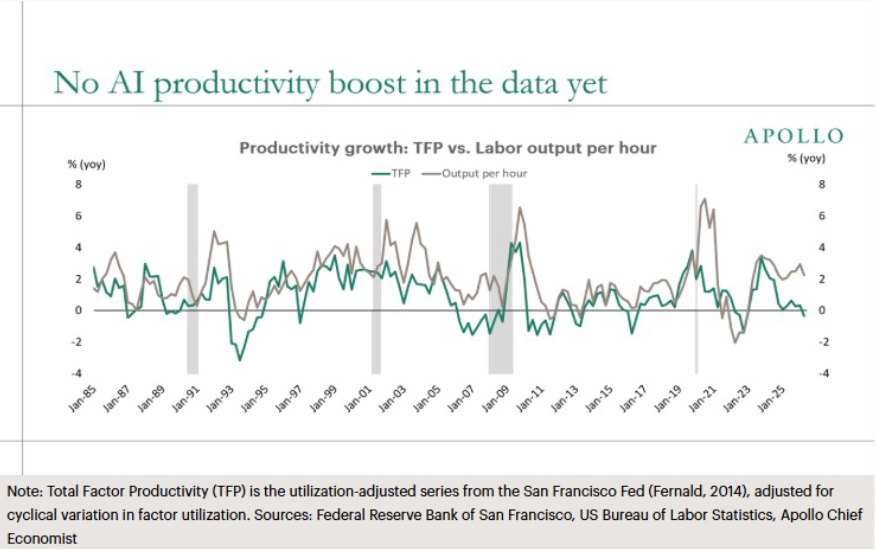
We are not suggesting that AI won’t be transformative. However, the hype may have outrun reality. Seeing proof of AI’s utility will be key to extending this boom and making a massive investment in AI payoffs.
Summary
The unstoppable juggernaut that is the US economy and stock market continues to march ahead. Economic and political noise can distract, but if earnings keep rising, so will stocks. We hope to see interest rates stabilize and market participation broaden so the world isn’t entirely dependent on AI.
We look forward to your thoughts, comments, and questions as we navigate these most interesting of times. As we enter the homestretch of 2026, we are also focused on year-end tax planning and compliance matters. If you have any specific questions about those issues, please let us know.