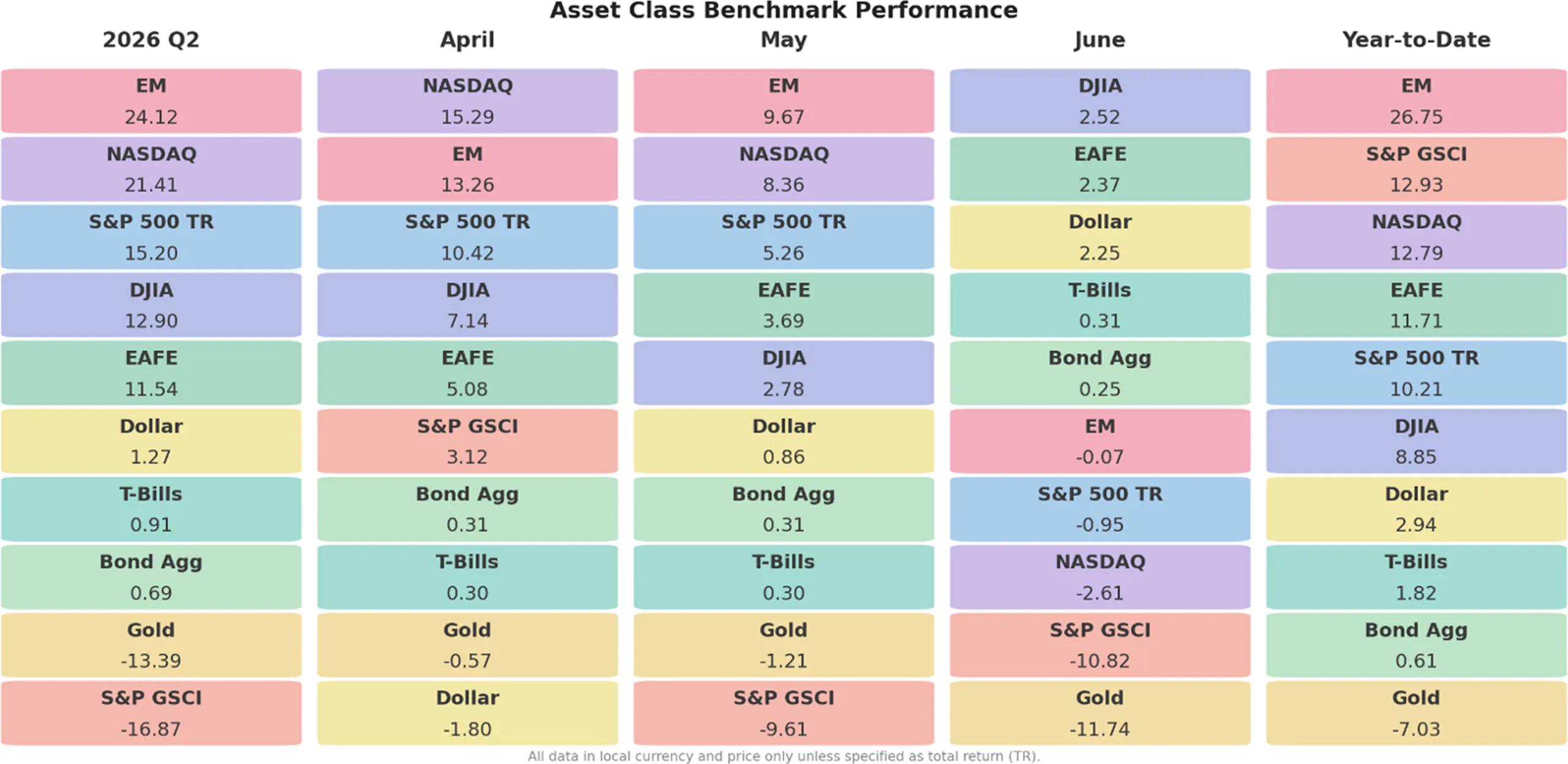
We are hard-pressed to recall a more volatile, yet positive, quarter for the financial markets. When the quarter began, the war with Iran commanded the world’s attention. Investors were reeling from the war’s financial impact and the disruption to commodity markets, particularly crude oil. The first quarter ended with the worst S&P 500 return in four years, and a fragile ceasefire seemed unlikely to hold.
As markets often do, price action surprised most. The Middle East situation settled down, though it’s far from over; more on that below. Oil moved back through the Strait of Hormuz, and prices made a complete round trip to levels seen in late February, before the conflict began. That, along with continued wild enthusiasm for AI, drove asset prices up. For the quarter, the S&P 500 returned 14.9%, its best quarterly return in six years, since the post-COVID recovery.
The broad market strength concealed wild volatility beneath the surface. Technology led the market, but within tech, the Mag 7 performed poorly while semiconductor and memory stocks surged domestically and internationally. Energy stocks gave back much of their first-quarter gains, while consumer stocks remained weak.
Bonds were weak again. As we noted last quarter, bonds typically rally amid global conflict and turmoil, but that wasn’t the case here. With interest rates pushing higher on ongoing inflation fears, bonds struggled again this quarter. Even more surprising, gold posted a double-digit loss; it appears gold was a source of liquidity for Middle Eastern nations facing oil-market disruptions. Cryptocurrencies also continued to struggle amid higher rates.
All of this comes against a very strong economic backdrop. Neither tariff turmoil, immigration policy changes, higher energy prices, nor political uncertainty have derailed an expanding economy. The AI building boom (we still see limited evidence of the promised AI productivity boom) continues to account for a disproportionate share of economic growth, with no signs of a slowdown in plans to spend hundreds of billions on computing capacity.
Market Review
As discussed earlier, a review of equity market results across the world wouldn’t provide any clue that a violent, kinetic conflict in the Middle East was ongoing:
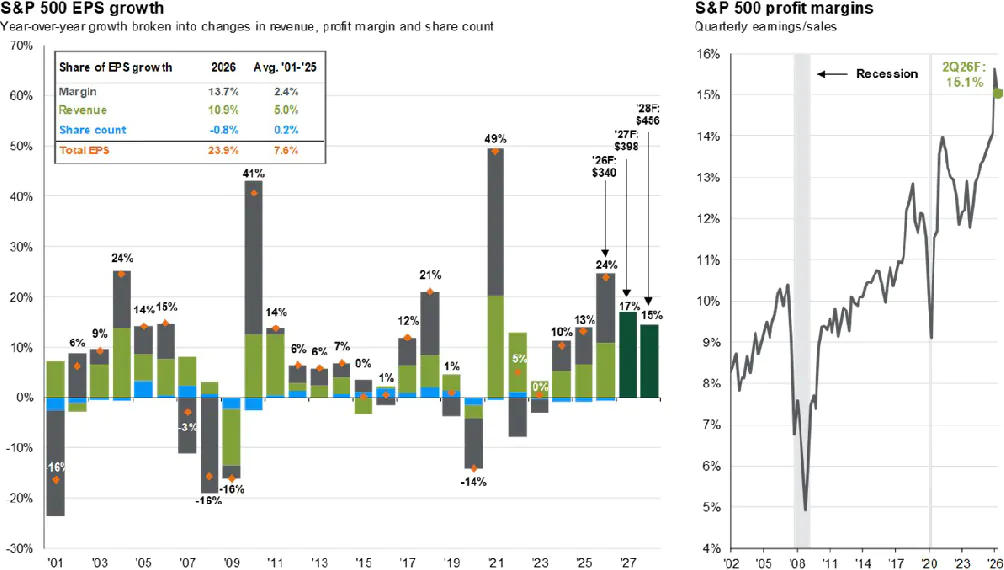
A strong and resilient economy accounts for much of the equity market strength, but powerful corporate earnings are key. As J.P. Morgan notes, earnings growth for the S&P 500 is expected to be 24% this year. That is a spectacular result, and one that we typically would only see as the economy emerged from a recession, not in the sixth year of an expansion. While the rate of earnings growth may change in the next few years, consensus estimates are for continued double-digit earnings growth with historically high profit margins. Even with our ever-present concern about valuation, it is hard to be too bearish with this picture:
The pause in the Iran war has had a meaningful impact on oil prices. WTI (West Texas Intermediate) Crude has nearly returned to prewar levels:
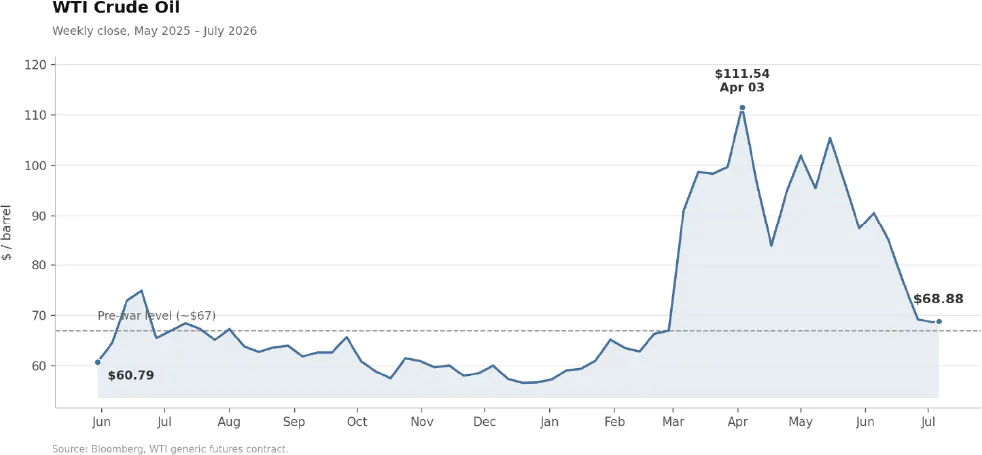
This recovery seems a bit hasty to us. Prices didn’t spike as high as in previous troubled periods because global inventories were drawn down dramatically. Now, those inventories need to be rebuilt even as ship traffic through the Strait of Hormuz remains far lower than it was prior to the conflict. There can be no doubt, however, that lower oil prices (and resulting lower gasoline prices at the pump) will improve consumer sentiment. As the chart below highlights, consumer sentiment is a wonderful, contrary indicator. When consumers feel gloomy, that often marks a good entry point for stocks. When consumers are optimistic, much of that outlook is already baked into equity prices and returns in the following year tend to be weak:
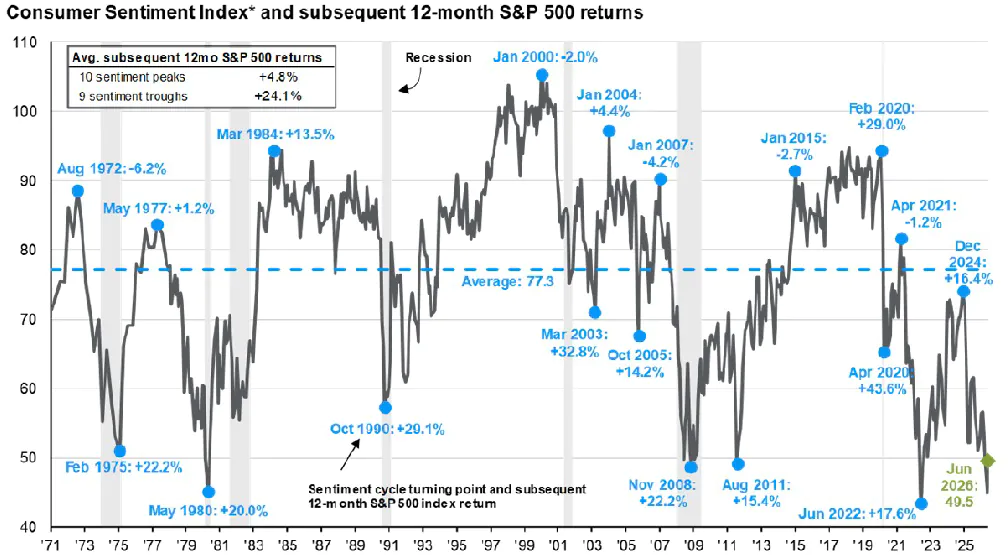
Given the weight of the evidence, we think the outlook for risk assets in the second half of the year is positive. High starting values may cap returns, but it appears that the path of least resistance is higher for the markets.
Three Key Issues for the Second Half of 2026
These issues strike us as important but underreported. We think all three will impact the markets in the second half of 2026.
War in the Middle East
The first involves the Memorandum of Understanding (MOU) that has formed the foundation of the current Middle East ceasefire. From our perspective, the MOA and its implementation thus far have been a disaster for the United States. Whether this ends up as a “Suez Canal” moment for the US is to be determined, but we are very discouraged by what we have seen so far.
When the conflict began, the US and Israel unleashed a “shock and awe” aerial campaign that was astonishing in its accuracy and ferocity. There can be no doubt that Iran’s military was severely degraded. But the lesson that air power can’t win a war had to be demonstrated again. It is obvious that even a degraded Iran could continue to inflict significant damage across the Middle East and could, ultimately, control the Strait of Hormuz.
Much of this capacity came from drones. As the war in Ukraine has highlighted, the nature of modern conflict has changed. Inexpensive drones, operated remotely, can inflict tremendous damage on troops, military equipment like tanks and ships, as well as civilian and military infrastructure. The US and its allies have worked hard to develop very sophisticated anti-missile defense systems. These complex and effective systems provide a level of protection that is unrivaled in military history.
However, drones create two challenges for a defensive system. The first is economic. Using multi million dollar missles to shoot down drones that can be quickly assembled and armed for a few thousand dollars can’t go on forever. This economic imbalance can be exacerbated by swarming attacks. The Ukrainian theatre sees the combatants launching hundreds or even thousands of drones against the enemy on a nightly basis. Defensive tactics exist, but like terrorism, even one or two drones evading defensive measures can create enormous damage. The human cost, according to reports, has been staggering, but the damage to infrastructure has been more dramatic. The Russians continue to launch brutal attacks against civilian targets while Ukraine is making attacks on Russian military and energy assets deep inside Russian territory.
In the Persian Gulf, Iran has used drones to attack neighboring countries, US military assets, and ships transiting the Strait. Despite the huge US Naval presence and the bellicose rhetoric from the administration, the Strait remained closed until Iran agreed not to attack ships. Does anyone believe that if the US had the ability, it would not have imposed its will on Iran and reopened the Strait?
We believe the US did not because it cannot. Our multi-million-dollar cruise missiles and bunker-busting bombs can cause enormous damage, but absent an invasion, we lack the capacity to stop drone attacks on naval vessels in the Persian Gulf. The Russians lack the ability to stop drone attacks on their oil and refining facilities. And we suspect that, as China eyes Taiwan, they may be realizing that they lack the ability to defend against drones that Taiwan might use if China invaded.
This change in the nature of war will have a huge and long-lasting impact. We think it likely portends more asymmetric conflict as nation-states or rogue actors decide they can inexpensively take the fight to a better-armed foe.
More immediately, we think that the exercise in Iran has severely compromised US standing. The US’s ability to project power and maintain open seas is now in doubt. Britain and France were never the same after they were humiliated by Egypt after the 1956 Suez Canal affair. We fear that the war in Iran may have a similar impact on the world’s policeman, the United States of America.
A New Federal Reserve Chair
Kevin Warsh was confirmed by the Senate and succeeded Jerome Powell as Fed Chair in mid-May. He was nominated by a man who wants, nay demands, lower interest rates. We are skeptical about whether the President will get what he wants.
Warsh was previously on the Fed Board of Governors, so he understands how the institution works. He has been a frequent writer and speaker about the Fed and monetary policy, and he has often been critical of the Powell Fed. His first press conference in June seemed to mark a sharp change in direction and tone for the central bank.
Of greatest importance, Warsh is focused on inflation. The Fed has a dual mandate to maintain full employment with stable prices. The employment picture seems to be taking care of itself as changes in immigration policy reduce the workforce and keep unemployment low. Warsh had little to say about the job market. His focus is on reducing inflation.
We applaud this new focus. Since his first press conference, interest rates on the long end have moved down, and market expectations on the short end have shifted from pricing in two cuts to one to two rate hikes. This, to our ear, sounds like a Fed restoring credibility.
Ultimately, the Fed will be judged by what it does, not what it says. The coming months will likely see many changes. Warsh has created five separate task forces to address various aspects of monetary policy and Fed operations, including communications, the balance sheet, data and productivity, and jobs.
We are particularly intrigued by changes in communications. We have all grown used to a transparent Fed. Ahead of meetings, speeches are given telegraphing Fed plans. At meetings, the assembled governors submit their interest rate forecasts, which are summarized in the now-famous “dot plot,” a roadmap for anticipated future Fed policy. Finally, after each meeting, the Fed releases a voluminous statement followed by a press conference where the Fed chair takes hours of questions.
This open and transparent Fed is the product of Ben Bernanke, and his successors have continued the effort. The goal has been to not surprise the markets. This couldn’t be in greater contrast to the late Alan Greenspan.
Chairman Greenspan was a man of few words who believed that actions were more important than words. He famously told a Senator that “If I seem unduly clear to you, you must have misunderstood what I said.” He gave infrequent speeches and rarely held press conferences.
Markets were often surprised by Fed actions. It became a parlor game to guess what the Fed would do based upon the thickness of the briefcase he carried into Fed meetings. A thick briefcase (presumably stuffed with charts and graphs) signaled a pending rate change. A thin briefcase, carried beneath his arm, signaled no change in policy. And there was certainly never a “dot plot” to guide investors.
We preferred this approach. The economy and markets are better served by some fear of the future. Excessive transparency leads to excessive risk taking. Kevin Warsh seems to agree. His first meeting statement was short, and his press conference was curt and largely uninformative. Moreover, he declined to submit a dot for the dot plot. We will be surprised if this forecasting exercise exists a year from now.
If this is the direction of travel for the Central Bank, we suspect that greater policy uncertainty will ultimately tamp down speculation and curtail wild price moves. Bond markets may slowly realize this, but other risk asset markets have much to learn.
AI
Volumes can and will be written about the evolution of AI. Since ChatGPT was released in 2022, the market has fixated on the development of AI models, the build-out of data centers to power the AI revolution, and wild and generally ill-informed speculation about the impact on jobs and the economy. Stay tuned, as only time will answer these questions.
The massive capital spending to create data centers to house computers to handle AI continues apace. The spending by the “hyperscalers” like Microsoft, Meta, Google and Amazon will amount to nearly $1 trillion this year. Eventually, those businesses will have to generate enormous revenues to earn acceptable returns on their investments. Knowing that, we were interested in the Wall Street Journal headline from June 10, 2026:
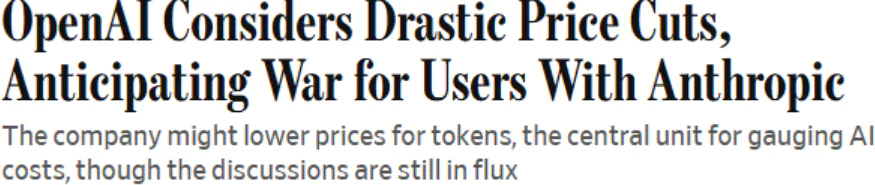
When we saw the story, we smiled with gratitude for the benefits of competition. With some additional reading, we began to ponder whether this development might be the reason that the “Mag 7” tech stocks have, more recently, become the “Lag 7”:
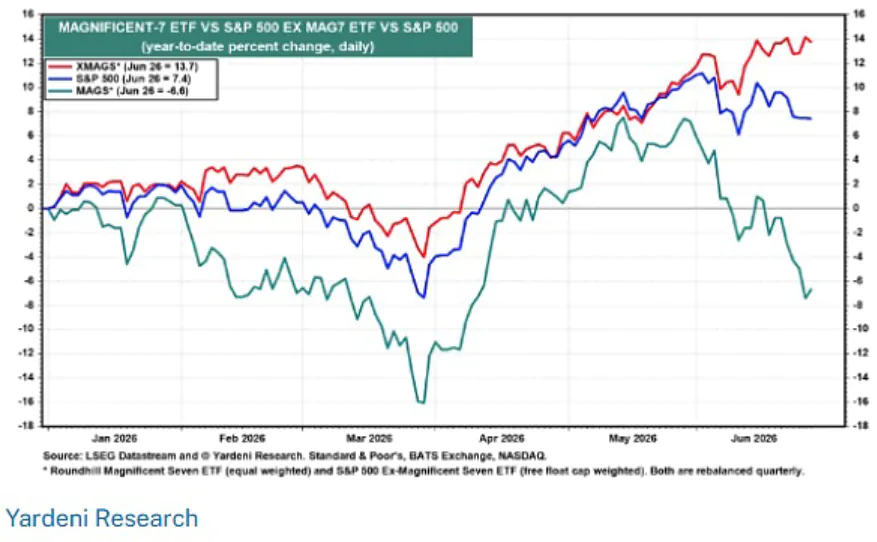
This underperformance is a sharp departure from 2025 when nothing but the Mag 7 seemed to work in the markets. This may be a healthy correction for the group, or the markets may be sniffing out the fact that not all of these companies will likely “win” the AI arms race. And for the winners, if the prospect of price cuts portends lower revenues, the massive capital investments might not pay off as much as investors hope.
Where do we go for the rest of the year?
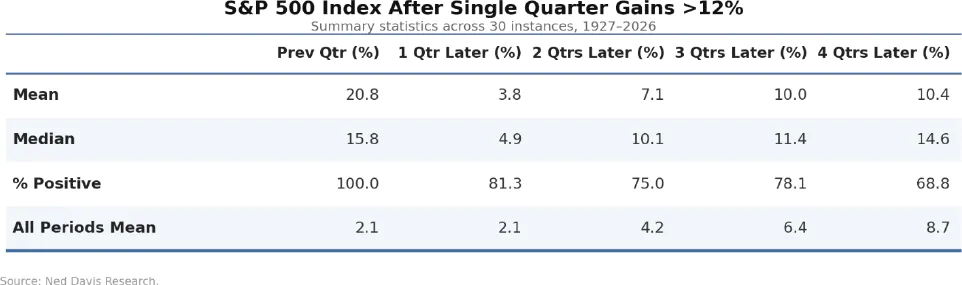
Particularly strong market quarters push valuations up and make many investors nervous. However, as Ned Davis observes, when the market rises more than 12% in a quarter, subsequent gains are generally strong and consistent: